Congress Serves Up Higher Energy Bills for July 4
As the United States celebrates 250 years, this Independence Day also marks the anniversary of the On Big Beautiful Bill Act (OBBBA)’s cuts to affordable renewable energy, food benefits and Medicaid.
We should be celebrating Independence Day with energy independence. Instead, Congress cut incentives for homegrown renewable energy that could have helped stabilize utility bills for us all.
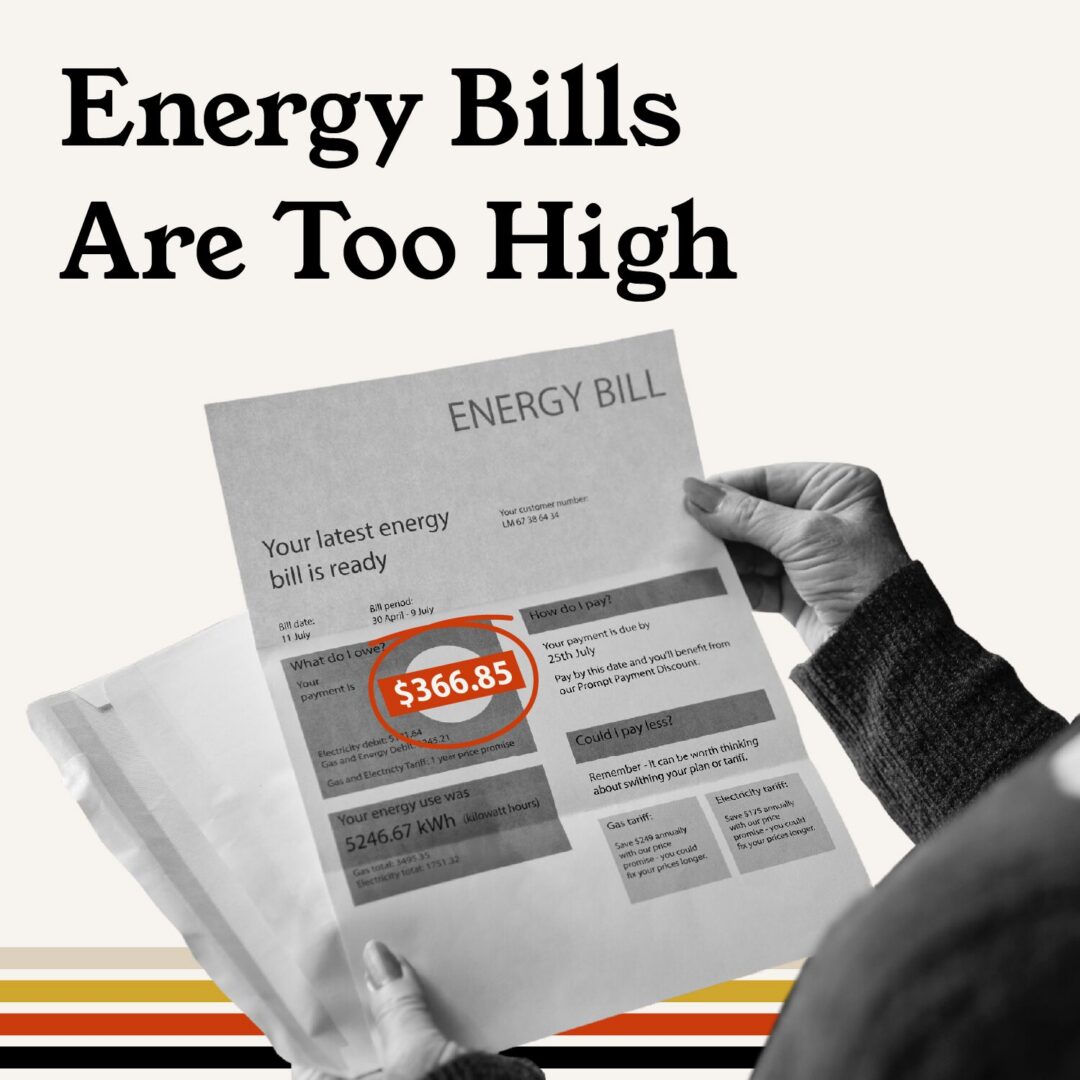
Energy Bills Were Already at Record Highs
On July 4th, 2025, the One Big Beautiful Bill Act (OBBBA) was signed into law, eliminating tax credits that had made cleaner, cheaper energy alternatives accessible to ordinary families. This pulls the rug out from under families seeking to escape rising electricity costs. Before its passage, energy costs were already at record highs. The average monthly electricity bill is now almost 30% higher than it was in 2021. Last year electric and gas utilities requested nearly $31 billion in rate increases, impacting the bills of 81 million Americans. In 2025 alone electric bills surged 13%. Unsurprisingly, 4 million households were disconnected from their utility service, 500,000 more than in 2024.
One of the biggest drivers of these soaring prices is the cost of natural gas. Benchmark price averages were 56% higher in 2025 than in 2024. Since utility companies pass fuel costs directly to consumers, when gas prices hike from global conflict, extreme weather or supply disruptions, bills do too. Solar and wind power are America’s solution with fixed and predictable costs.The OBBBA kneecapped these technologies and the Trump administration ensnarled them in red tape.
The Renewable Energy Tax Credits the OBBBA Eliminated
Previously, homeowners were able to offset the costs of installing solar panels on their rooftops, battery storage units, and heat pumps through the 30% Residential Clean Energy Credit. These technologies lowered monthly bills for families by reducing their dependence on grid electricity. The credit typically saved families around $6,000 on the average $20,000 solar installation, proving to be a make-or-break factor for the average homeowner that is now gone.
Key incentives that drove utility-scale solar and wind projects across the country, the Investment Tax Credit and Production Tax Credit, were also gutted. Through the OBBBA, the phase-out of these credits was accelerated, leaving most solar and wind projects required to begin construction by July 4th, 2026, or be completely operational by December 31st, 2027, in order to qualify. With fewer new solar and wind projects being implemented, there is less low-cost electricity entering the grid.
The OBBBA rescinded the remaining funding from the $27 billion Greenhouse Gas Reduction Fund, a vital incentive that supported clean energy projects in low-income communities. Federal tax credits for new and used electric vehicles, commercial EVs, and EV charging stations were eliminated after 2025. The Waste Emissions Charge on excess methane emissions was delayed until 2034, with remaining funding to reduce methane in the atmosphere revoked. In a single law, renewable energy initiatives, clean transportation incentives, and air quality safety standards were dismantled, threatening the pocketbooks of the average American.
The Impact on American Families
The backpedaling on renewable energy accomplished through the OBBBA has cut straight into the budget of American families. The average household’s utility bill is projected to increase by $190 per year. This jump comes on top of already record-breaking utility bills and cost-of-living pressures, with one estimate placing the additional cost to the average household at $1,508 since January 2025.
The impact of the OBBBA is clear. With fewer credits accessible to the public, fewer solar and wind projects are being constructed to meet rising demand. Fewer projects mean less low-cost energy on the grid. Less low-cost energy on the grid results in further dependence on natural gas for energy, which is highly volatile in global markets and saddles consumers with the costs. We won’t have as much energy as we could, and people will pay for that.
Renewable Energy Will Keep Growing, But Families Pay More in the Meantime
Despite the attacks, renewable energy will continue to grow, especially solar and battery storage. The economics are just too favorable. These technologies really are the cheapest source of new power to add to the grid in most places. Last year storage had a banner year and that trend is continuing. We have all this new demand for electricity and markets will continue to opt for the fastest, most affordable form of power, which in most cases is renewable.
The Safety Net Cuts That Come With It
Beyond its elimination of cheaper energy options, the OBBBA also cut the safety net for those most exposed to higher bills. The law enacted the largest Medicaid cuts in United States history, leaving over 10 million people projected to lose coverage by 2034. The OBBBA also cut $186 billion from the Supplemental Nutrition Assistance Program (SNAP), leaving an estimated 3 million Americans without food assistance. With higher energy bills, fewer healthcare options, and less food assistance, this law stacks pressures on already struggling households.
Predictable and stable energy costs are possible, they just require more stable, homegrown electricity sources. The OBBBA moved the nation in the opposite direction, at the worst possible time.